Automate Your Incident Management
Incident management is what happens after a monitor fails: someone gets notified, someone owns it, and everyone, including your customers, sees what’s happening until it’s resolved. Zunoy’s incident management software handles the whole chain automatically, from the first alert to the postmortem.
Incident Risk
What Happens Without A Real Incident Response
No one owns it
No one owns it
The story gets lost
The story gets lost
What happened and who did what, scattered across five panicked chat threads.
Customers are left guessing
Customers are left guessing
They refresh the page, get nothing, and start typing an angry email.
Nothing gets reviewed
Nothing gets reviewed
Without a record, the exact same failure quietly happens again next month.
Lifecycle
Three Stages With Zero Guesswork
STEP 1
Triggered
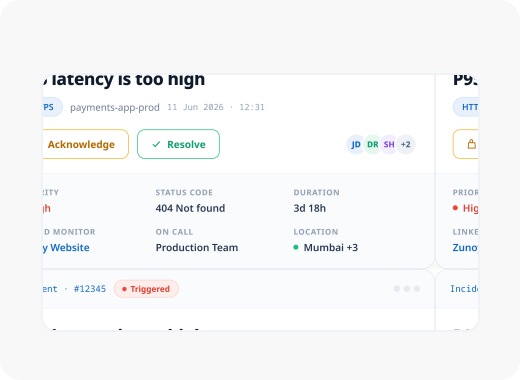
A monitor fails past your threshold and opens an incident automatically, or your team declares one manually with its own severity. It routes to whoever's on call.
See below for how that routing works under an on-call schedule

STEP 2
Acknowledged
The responder claims it, or it escalates to the next person in the chain if nobody responds within your set window. Two things kick in once it's claimed:
Create Tasks to manage the incident response.
Set up an SLA Target to improve reliability

STEP 3
Resolved
The incident closes, the full timeline saves, and you're ready to write the postmortem, or have Zunoy AI draft one to start from.
AI
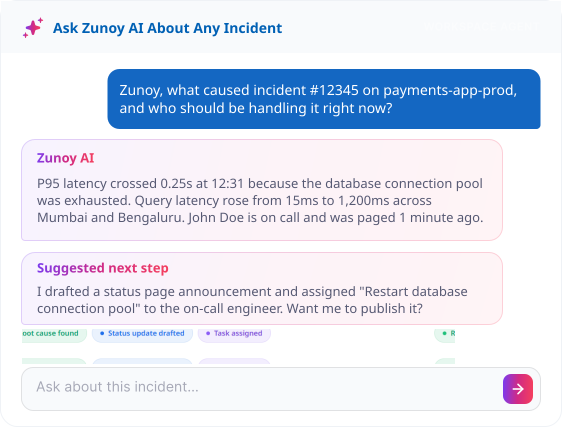
Ask Zunoy AI About Any Incident
Not sure what happened, or what to do next? Just ask.

AI MCP
Set up an MCP Server and ask it anything in a natural language

AI SRE
AI SRE filters the noise around the clock, so only a real failure ever wakes someone up at 3 AM.

AI Agent
AI Agent explains what happened, suggests a next step, and can even draft your postmortem afterward.
PREMIUM
More than Just Incident Response
Coverage That's Never a Guess
It's 2 AM, and someone's actually watching. Build rotations across your teams and members, so ownership during an active incident is clear from the first second, never assumed.
No per-user pricing
Ownership never assumed
Overlapping coverage when needed
Rotations across every team
On-Call SchedulingNothing Falls Through the Cracks
If the first person doesn’t acknowledge in time, it climbs to the next one automatically, escalating by severity, by team, or however your incident management workflow actually runs.
Escalates when unacknowledged
Fully customizable time window
Routes by severity or team
Multi-channel, not just one ping
Escalation Policies
Oversight
Full Oversight for Every Incident
Not every incident needs the same three people doing everything. Split ownership across teams, close the loop with a record, and know exactly who touched what along the way.

Ownership at Every Stage
Build separate teams for detection, response, and communication, so no single person is carrying the whole incident alone.

Every Incident Ends With a Record
Write it yourself, or let Zunoy AI draft one from the incident's own timeline, what triggered it, what changed, what to fix, so you're editing instead of starting from a blank page.

Nothing Happens Off the Log
Every check change, escalation update, and acknowledgement is logged and attributed, so whoever's leading the team always knows exactly who touched what.

Status Sync
The Incident Told in Real Time
Customers shouldn't have to ask if it's down, they should just see it.
Your status page updates in real time.
Visitors see the full history, not just today's status.
Restrict visibility of internal incidents
Use Cases
Where Incident Management Actually Helps
- SAAS
SaaS Companies
A failed deploy trips a monitor, pages the right engineer in under a minute, and the postmortem is half-written before the fix even ships.
- E-COMM
e-Commerce Teams
A checkout outage escalates automatically when the first responder is asleep, instead of sitting unacknowledged until morning.
- ENTERPRISE
Enterprise Teams
Every client gets their own escalation chain, so a problem on one account never pages the wrong team.
- IT
IT Teams
Audit logs answer "who changed that monitor" without anyone having to ask around.
FAQ
Incident Management FAQs
What is incident management?
Incident management is the process of detecting a failure, notifying the right person, tracking the response, and documenting what happened. In Zunoy Uptime’s incident management system, every incident is tied to the monitor that caught it, so detection, response, and records stay in one place.
What happens if an incident alert isn’t acknowledged?
The alert escalates to the next person in your escalation chain. You set the escalation window yourself, so you decide how long an alert waits before moving to the next responder.
Can I control who can edit monitors and who only receives alerts?
Yes. Zunoy Uptime lets you assign each team member an Admin, Write, Read, or Alert-Only role. Alert-Only members get notified without being able to change monitor settings.
How is an incident created in Zunoy Uptime?
Incidents are created in two ways. Zunoy Uptime opens one automatically when a monitor fails past your confirmation threshold, or your team can declare one manually with its own severity. Manual incidents get the same timeline, escalation, and postmortem treatment as automatic ones.
Can more than one person be on call at the same time?
Yes. Zunoy Uptime lets you build on-call rotations with overlapping coverage, so you aren’t limited to a single responder per shift.
What are incident tasks?
Incident tasks are a checklist attached to an incident, covering steps like assigning roles, updating the status page, or checking the triage dashboard. Each task has an owner, a due date, and a status you track as To-Do, In Progress, or Completed.
Ownership
Give Every Outage an Owner
A failed check shouldn’t just sit quietly in a log. The moment something breaks, it becomes a tracked incident in your incident tracking software, assigned to someone, timestamped, and moving through its own lifecycle. No more piecing together what happened from a Slack thread after the fact.
Assigned automatically
Escalated on schedule
Logged for the record
Postmortem with Zunoy AI