Website Status Page for Real-Time Uptime and Incident Updates
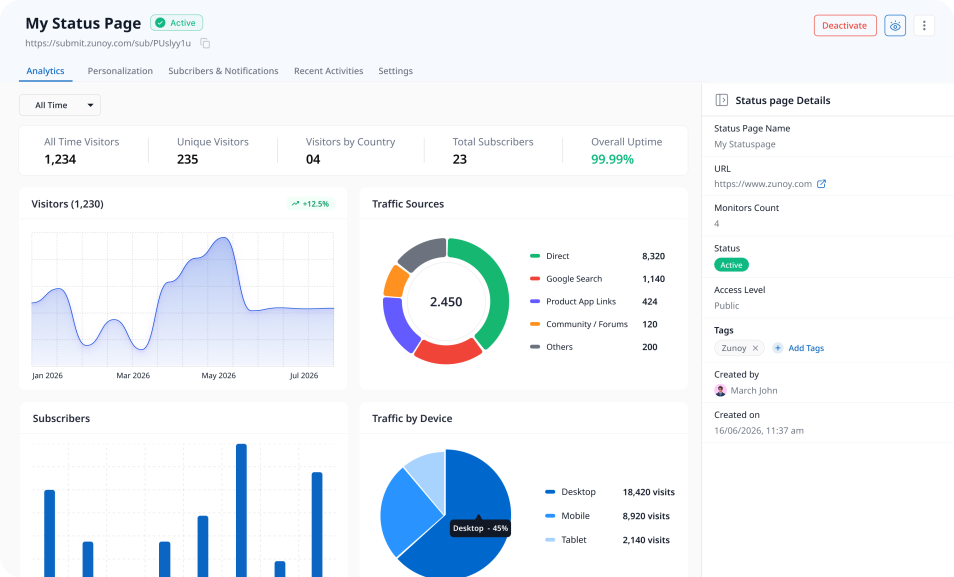
A website status page gives customers and teams a real-time view of service availability, uptime, incidents, and maintenance. Zunoy Uptime keeps it updated automatically, so users can quickly answer, “Is this down for everyone?” without opening a support ticket.
Here's What This Actually Saves You

Fewer support tickets
When something breaks, visitors check your website status page instead of emailing your team.

One source of truth
Your team and your customers see the same real-time status page.
HUB
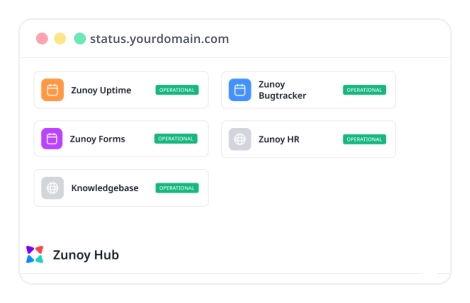
A Status Hub for Every Product You Run
Running more than one product usually means running more than one status page. A Status Hub groups them under a single URL, with shared branding, and shows the operational status of every linked page from one place. Add or remove linked pages at any time, and save the hub as a draft while you're still setting it up.
Custom hub URL slug, checked for availability before you publish
Global incidents shown across every linked page, not just one
One operational summary instead of five separate ones
Get Your Website Status Page Running In A Minute

Step 1
Name Your Page
Every status page starts with a name and a slug. Zunoy Uptime keeps the internal name separate from what visitors actually see.
Internal & Public Name
Internal & Public Name
Custom Slug
Custom Slug
Choose your own URL slug, checked for availability as you type.
Tags
Tags
Add tags to keep multiple status pages organized as your workspace grows.
Step 2
Choose Your Monitors
Pick which monitors show up, and how they're grouped, before anyone sees the page live.
Select Monitors
Select Monitors
Group & Order
Group & Order
Organize monitors into sections, and drag them into the order that makes sense.
Visualization Style
Visualization Style
Choose how each monitor's status displays, list or grid, per monitor.


Step 3
Brand and Localize It
Make the page look like yours, not a third-party tool, and set it up for the audience actually viewing it.
Logo & Colors
Logo & Colors
Custom Domain
Custom Domain
Host the page on your own domain instead of a Zunoy subdomain, verified through DNS.
Locale & Format
Locale & Format
Set a default language, date format, and time format for the audience viewing the page.
Step 4
Turn On Notifications
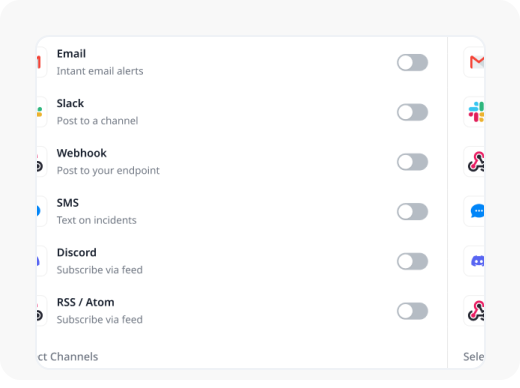
Decide how visitors find out about a change, and how incidents reach the page automatically.
Subscribe Button
Subscribe Button
Incident Sync
Incident Sync
Incidents on linked monitors sync to the page automatically, no manual update needed.
Step 5
Publishing & More
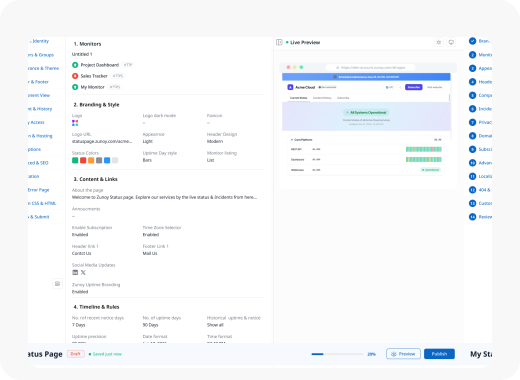
Handle planned downtime ahead of time, then preview and publish when it's ready.
Preview & Publish
Preview & Publish
Maintenance Window (Optional)
Maintenance Window (Optional)
Schedule planned work so it shows as maintenance, not an outage.
LIVE
See What Your Uptime Status Page Shows in Real Time
- 01
Current Status
Operational, degraded, or down, updated the moment a check runs
- 02
Uptime Percentage
A running record measured against your SLA, including P95 availability.
- 03
Recent Downtime
The last outage with the incidents mentioned, visible right where visitors look.
- 04
Uptime History
A calendar view of how each service has actually performed.
WIDGET
Embed Your Status Widget Anywhere
A status widget pulls live data from your uptime status page and embeds it wherever you need it: your app, internal dashboard, or website with no separate page required.

Scenarios
See Where This Actually Pays Off
- SAAS
SaaS Companies
A shared outage no longer means fifty identical tickets asking the same question.
- OSS
Open Source Maintainers
Contributors see infrastructure health without pinging you on Discord.
- IT
Enterprise & IT
Internal teams get a private system status page instead of a company-wide email thread.
- API
API Providers
Developers check your status before opening a ticket about their own code.
Quick Answers About Website Status Pages
What is a status page?
A status page is a public or private page showing the live status, uptime, response time, and incident history of your services, built from your existing monitors.
Can I use my own domain?
Yes. Run a hosted status page on your own custom domain instead of a Zunoy subdomain.
Can I make my status page private?
Yes. Restrict access with a password or limit it to specific email domains, instead of publishing it as a public status page.
What is a Status Hub?
A Status Hub groups multiple status pages under one shared URL, useful if you run more than one product or service.
Publish Your Status Page
Show uptime, response time, and incident history on a website status page customers can check without contacting support. Publish it once, and it stays updated automatically.
Live uptime and response time
Full incident history, always visible
Branded with your own domain
Visitors can subscribe for updates