Your AI Co-Pilot for Every Bug
Zunoy AI helps teams create cleaner bugs, detect duplicates, suggest severity, assign the right owner, summarize activity, search naturally, and convert resolved bugs into knowledge base records. It's the AI-powered bug tracker built to move issues from capture to closure without the busywork.

Smarter Prioritization
Duplicate Detection
Natural Language Search
Activity Summaries
Reusable Knowledge
AI Features
Eight AI features built into your Bug Workflow
Every feature works inside the AI bug tracker — no switching tools, no extra prompts.
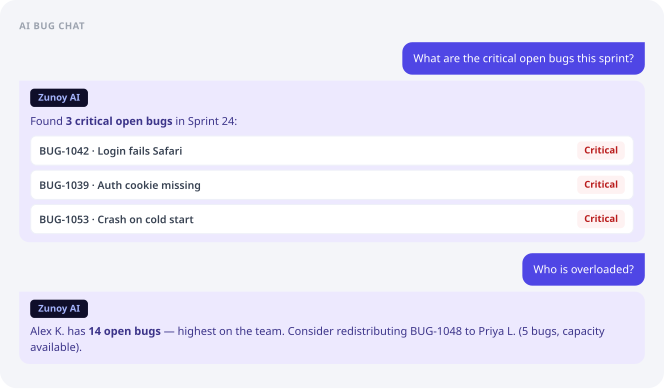
Bug Workflow Chat
Ask questions about bugs, blockers, assignments, activity, and recent updates without opening every issue manually — a core part of AI bug management.

Find open, assigned, overdue, or high-priority bugs
Ask what changed in a project or bug thread
Get quick answers from bug activity and context
Help QA, dev, and managers stay aligned
Smart Bug Editor
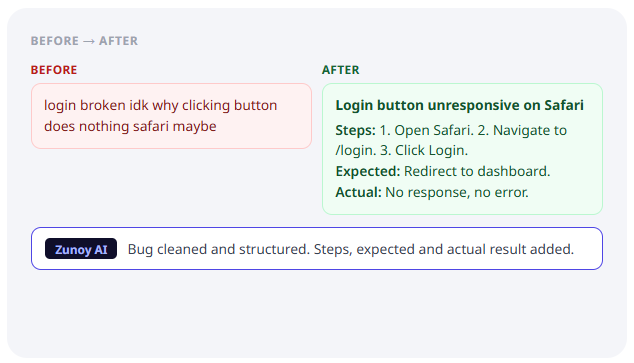
Clean up rough bug notes, comments, and closure drafts into clear, developer-ready content.
Rewrite unclear bug descriptions
Structure summary, steps, expected result, and actual result
Improve comments and resolution notes
Make bugs easier to understand and act on
Bug Creation Assistant
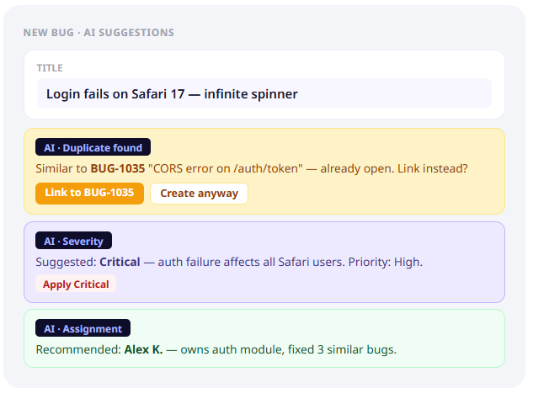
Improve bug quality before the issue enters the workflow — with smart triage suggestions as you type.
Detect similar or duplicate bugs automatically
Suggest severity from bug details and context
Recommend the right team member to assign
Reduce manual triage for QA leads and managers
Natural Language Search
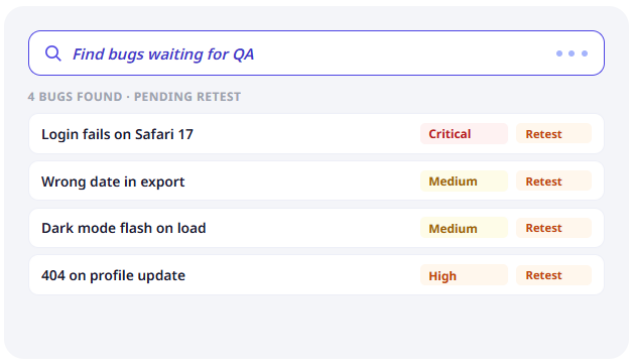
Find bugs by asking simple questions instead of building filters.
Search by status, severity, owner, module, or project
Ask plain-language questions during reviews or standups
Find older bugs without remembering exact titles
Example Queries:
"Show high severity login bugs"
"Find bugs waiting for QA"
"Show mobile bugs from last week"
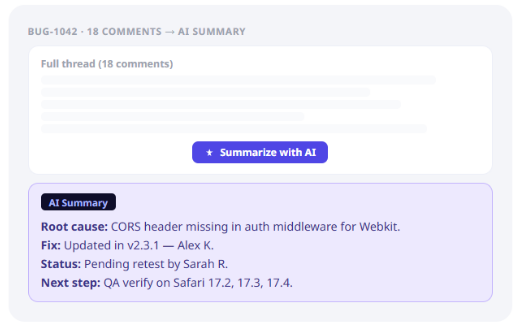
Bug Activity Summary
Turn long bug threads into short summaries your team can understand fast.
Summarize comments, activity, and status changes
Highlight key decisions and progress updates
Help developers understand issue history faster
Prepare summaries for closure or documentation
Knowledge Base Support
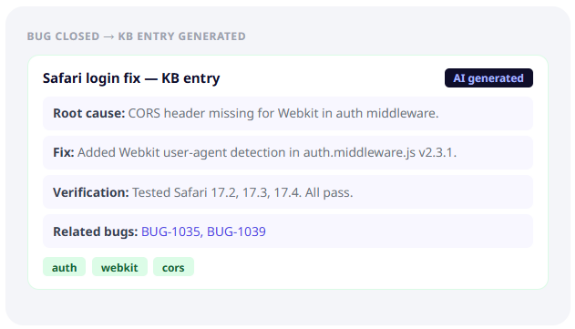
Convert resolved bugs into reusable knowledge so fixes do not disappear after closure.
Create knowledge base drafts from bug activity
Link related bugs, fixes, and root causes
Reuse past resolutions for similar issues
Preserve lessons learned for future debugging
Bug Closure Assistant
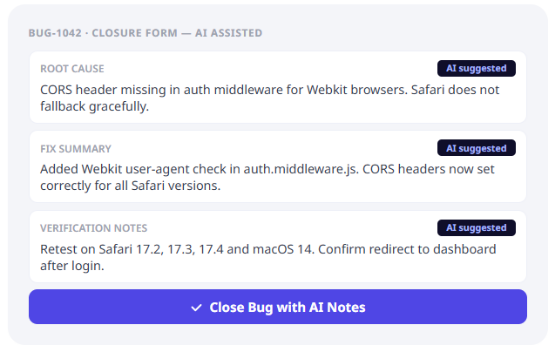
Close bugs with better root cause, fix summary, verification notes, and linked knowledge base details.
Suggest root cause from activity and communication
Summarize what was fixed
Prepare QA verification notes automatically
Convert closure details into knowledge base records
MCP Server for Bug Management
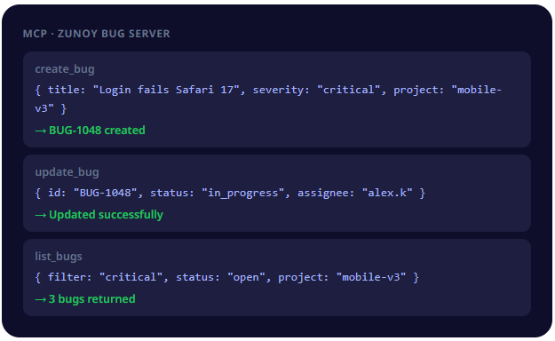
Let connected AI tools manage bugs through structured create, read, update, and delete operations.
Create bugs from connected AI environments
Read bug details, status, and activity
Update status, assignee, or custom fields
Manage bug workflows through connected operations
BUG LIFECYCLE
AI Built Into the Way Bugs Actually Move
Zunoy AI supports the complete bug workflow, not just one isolated task.
Capture
Turns rough inputs into cleaner bug reports — powered by AI bug reporting tool.
De-duplicate
Checks similar bugs before the backlog gets filled with repeated reports.
Prioritize
Suggests severity, priority signals, and affected area so teams can act faster.
Route
Recommends the right owner based on module, component, bug type, or past activity.
Understand
Summarizes long threads, comments, activity logs, status changes, and decisions.
Resolve
Helps prepare root cause, fix summary, verification notes, and closure details.
Remember
Converts closed bugs into knowledge base records with root cause, fixes, related bugs, and lessons learned.
BENEFITS
How AI Makes Zunoy Bug Tracker More Useful
As an AI bug tracker, Zunoy delivers AI bug management across every stage of the bug lifecycle.

Cleaner bug reports from the start
Turn messy notes into structured reports with steps, expected results, and technical context developers need.

Faster triage with less manual review
Duplicate detection, severity suggestions, and assignee recommendations help QA leads move bugs faster.

More useful knowledge base records
Resolved bugs become reusable knowledge base entries — making future debugging faster and reducing repeated mistakes.

Fewer duplicate bugs in the backlog
AI checks for similar issues before new bugs are created, reducing repeated reports and wasted developer effort.

Easier bug search for everyone
Natural language search helps QA, developers, PMs, and support find bugs without complex filters or query syntax.

Better developer handoffs
AI summaries help developers understand what happened, what changed, and what needs attention without reading full threads.

Stronger root cause documentation
AI suggests root cause, fix summary, and verification notes during closure — preserving technical learning instead of losing it after the bug is marked done.
USE CASES
How teams use Zunoy AI
Seven ways AI helps QA, developers, product, and engineering teams work faster inside the AI bug tracker.
The things Developers actually ask
What is an AI bug tracker?
An AI bug tracker is bug management software that uses AI to create, triage, assign, search, summarize, close, and document bugs faster.
Can Zunoy AI suggest severity?
Yes. AI can suggest severity based on bug details, screenshots, logs, affected modules, and available context.
Does Zunoy AI detect duplicate bugs?
Yes. Zunoy AI can detect similar existing bugs during creation to reduce duplicate reports and repeated developer work.
Can AI suggest who should fix a bug?
Yes. Zunoy AI can recommend a team member based on bug type, component, module, ownership history, or related activity.
Get Started
Fix Bugs Faster With AI-Powered Bug Tracker
Use Zunoy AI, intelligent bug tracking built for dev and QA teams, to create better bug reports, reduce duplicate issues, assign bugs faster, summarize activity, search naturally, and turn every resolved bug into reusable knowledge.
Smarter prioritization
Duplicate detection
Natural search
Activity summaries
Reusable knowledge