It Can Only Tell Visitors What You Actually Published
Zunoy's AI chatbot retrieves from your published content before answering, cites the entries it used, and scores its own confidence.
Answers From Your Content, Not a Guess
Zunoy's chatbot searches your published content for relevant passages before it answers, rather than answering from general training data. It generates its response from what it finds, and attaches the sources it used.
Generic chatbot
Answers from training data plus a short brief
Invents plausible detail when it doesn't know
A brief someone has to remember to update
No way to check where an answer came from
Zunoy's chatbot
Answers from passages retrieved out of your content
Weak retrieval scores expose the gap instead
Publishing content is what updates it
Every answer carries its sources
What Makes the Answers Trustworthy
Three properties do the work: retrieval happens before generation, sources travel with the answer, and every retrieval carries a relevance score that makes low-confidence responses identifiable rather than hidden.
- Sources
Cited sources
Each answer carries the content entries it was built from.
- Scoring
Relevance scoring
Every source has a score, so weak-match answers are visible.
- Retrieval
Semantic retrieval
Matches meaning, so visitors needn't use your exact terminology.
- Shared Index
One shared index
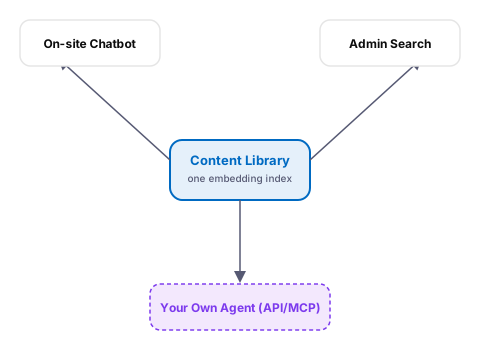
The same embeddings power admin search and the public chatbot.
Your Form Submissions Cannot Be Surfaced
Zunoy deliberately excludes form submission data from the embedding index. Submissions contain personal information belonging to identifiable people, and indexing it would turn a search feature into a compliance liability. The chatbot can discuss your published content; it structurally cannot leak what someone typed into your contact form.
Chatbot Questions Show You What's Missing

Every query logged
With its retrieval quality

Low-score questions ranked
As a content gap list

Real intent data
From your own visitors, not a keyword tool
FOR DEVELOPERS
Give Your Own AI Agents Access to This Content
The same retrieval layer is available as an API returning pre-chunked context, so agents you build can use your content as a knowledge source. Paired with the MCP server, your CMS becomes a content backend for AI experiences outside Zunoy. A support agent, an internal assistant, a product feature — all can draw from the same content your marketing site uses, without a second pipeline keeping a duplicate corpus in sync.
Pre-chunked RAG context over HTTP
The same index that powers on-site chat and admin search
No duplicate knowledge base to maintain
How It Works
Publishing is the only ongoing action required — indexing, retrieval, and citation happen without a maintenance workflow.
Who This Is For
Support teams
Deflect repetitive questions using documentation you already maintain, without writing and syncing a separate help-bot knowledge base.
Answers update when your docs are published
Citations let visitors verify and read further
Content strategists
Unanswered questions ranked by frequency, which beats keyword research for accuracy about what your audience actually wants to know.
Content gaps identified by real visitor demand
Developers
A retrieval API for building your own agents rather than a hosted widget you can't extend or embed where you need it.
Pre-chunked context endpoint plus MCP tooling
Compliance-conscious teams
A grounded architecture that reduces fabrication risk, and an index that excludes personal data by design rather than by policy.
Submission data structurally out of scope
Connected to the Rest of the Platform
The chatbot isn't a separate product — it's one surface of the intelligence layer that also powers editing and search.
Common Questions
Does the chatbot answer from my own content?
Yes. It retrieves relevant passages from your published content and generates answers from them, rather than responding from general training data or a separately maintained knowledge base you have to keep updated.
How do I know when the chatbot is unsure?
Every answer records how many sources matched and the relevance score of the strongest match. Low scores indicate the question falls outside your published content, surfacing as a signal rather than being hidden.
Can the chatbot expose my form submissions?
No. Form submissions are deliberately excluded from the embedding index because they contain personal data, so the chatbot cannot surface information submitted through your forms under any query.
Can it show where an answer came from?
Yes. Each answer carries the sources it was generated from along with a relevance score per source, so responses can be verified and visitors can click through to read the full content.
Does it only match exact keywords?
No. Retrieval is semantic, matching on meaning, so visitors get relevant answers even when their phrasing differs entirely from the terminology used in your published content.
Is the chatbot separate from AI Studio?
No. It shares the same embedding index and retrieval layer powering AI Studio's semantic search and editing actions, so there is no second system to configure or keep synchronized with your content.
Stop Maintaining a Second Version of the Truth
Your documentation is already written. It may as well be able to answer questions.