Same Starting Point, Different Amount of Assembly
Strapi and Zunoy both give you a schema-first content engine and a real REST API. Where they diverge is everything built around that engine, and how much of it you're expected to source and pay for separately.
What the Same Price Actually Buys You
Strapi Cloud's published pricing vs. Zunoy's live plan data, at matching price points. Strapi meters infrastructure; Zunoy tiers on team size, AI usage, and locales instead.

Zunoy Growth
$49
/moAPI requests/month: Not metered by request volume
Asset storage: Not metered separately
Asset bandwidth: Not metered separately
Backups: Not published
Contributors: 20
AI credits/month: 1,000
Locales: AI Translation
Custom domain: Included
Native forms: Included
Native cookie consent: Included
Visual page builder: Included
MCP server for AI agents: Included
VS
VS

Strapi Starter
$35
/moAPI requests/month: 100K
Asset storage: 50 GB
Asset bandwidth: 50 GB
Backups
Contributors: Not published
AI credits/month
Locales: Not published
Custom domain: Included
Native forms
Native cookie consent
Visual page builder
MCP server for AI agents
Read This Table as "What's Bundled," Not "Who's Cheaper"
Strapi meters infrastructure — API requests, storage, bandwidth — Zunoy doesn't publish those limits
Zunoy tiers instead on team size, AI credits, and locale support
AI, forms, consent, and a visual builder ship free on Zunoy — sourced separately on Strapi
THE REAL TRADE-OFF
A Wide Marketplace Versus a Short List That's Already On
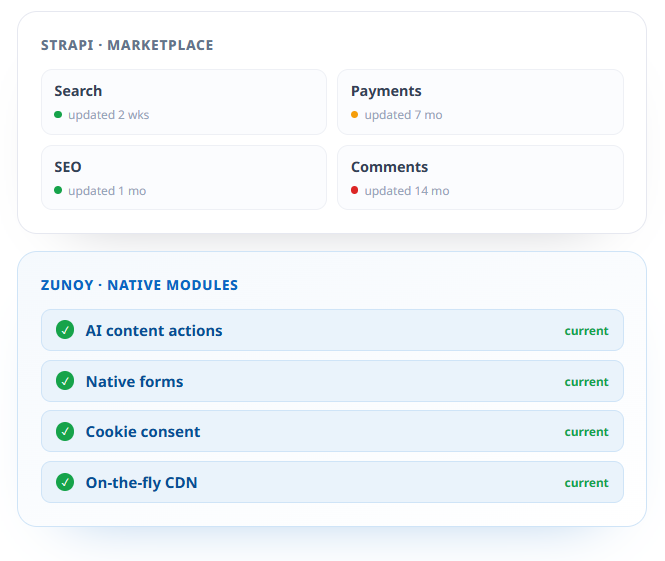
Strapi's plugin marketplace is genuinely wide, but each plugin is a separate integration to evaluate and maintain. Zunoy trades that breadth for a shorter list of native modules that ship as part of the platform core.
Strapi: broader ecosystem, integration work per module you adopt
Zunoy: narrower module set, no integration work to turn one on
Both give you a real, typed content API underneath either choice
Self-hosted Strapi
Full infrastructure control, and full responsibility for it
Strapi Cloud
Managed, priced per project as shown in the table above
Zunoy
Hosted on every plan, nothing to provision for the CMS layer
INFRASTRUCTURE
Who Owns the Server Your CMS Runs On
Strapi runs self-hosted or on Strapi Cloud, so a self-hosted deployment is your team's responsibility to provision, patch, and scale. Zunoy is a hosted platform — there's no server to manage for the CMS itself, on any plan.
Three Questions That Actually Decide This
Most Strapi-versus-Zunoy evaluations come down to three questions. Answer these honestly before comparing feature lists further.

Do you have DevOps capacity?
Self-hosted Strapi needs someone to own the server. Zunoy doesn't.

Who's building pages — devs or editors?
Strapi has no native visual builder. Editors need one to move fast.

Do you want AI acting on content, not just drafting it?
Zunoy's MCP server is native. Strapi has none, as of writing.
Who Actually Fits Where
Strapi tends to fit
Teams with existing DevOps capacity who want maximum control over hosting and are comfortable evaluating and maintaining third-party plugins for anything beyond core content.
Full self-hosting control, including data residency by default
A large open plugin ecosystem to draw from
Zunoy tends to fit
Teams who want forms, delivery, and consent working without a procurement cycle, and who want AI that can act on content structure, not just suggest text for it.
No infrastructure to provision for the CMS itself
A native MCP server and in-app agent with no plugin required
Go Deeper on the Specific Differences
Rather than take this page's word for it, see the modules directly.
Try the Native Modules Yourself
Model a content type, build a page, and connect an AI agent — all without installing a plugin first.

CMS
A headless CMS to model content and ship it anywhere.
Operational
Integrations
Mail Us
support@zunoy.com
Copyright © 2026 - Mentcube Innovations Pvt Ltd.. All Rights Reserved.
v0.1.101 · Built Aug 12, 2026, 4:13 AM