SLA Reporting to Track Compliance and Uptime Performance
SLA Reporting helps you measure service performance against your agreed service level targets. With Zunoy Uptime’s SLA management software, track SLA compliance, total downtime, incident response and resolution times, and identify missed targets. Export reports to review performance and share results with stakeholders.

SLA CALCULATION
See What Your Target Actually Allows
99.5% sounds close enough to perfect, until you see what it actually buys you in minutes. Type in your target, and find out exactly how much downtime it allows before you're the one explaining the gap to a client.

How Your SLA Target Is Tracked
Create a Monitor
checkout.zunoy.com, checked every 30 seconds.
Set Your SLA Target
Define the target, and link the escalation policy that keeps it on track.
Incident Occurs
An incident opens automatically, and the clock starts against its SLA target.
Deadline Gets Close
Add escalation steps as the target breach comes closer.
Connected
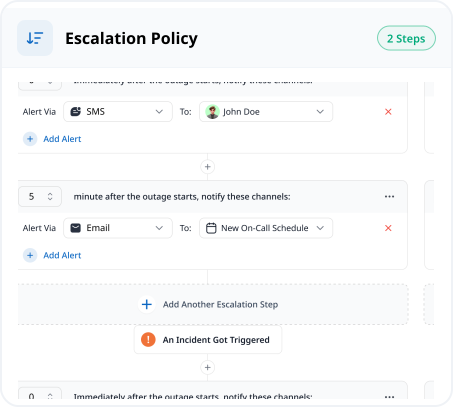
Escalation Policies Don't Just Manage Incidents
An escalation policy isn't only there to route an incident to the right person. Linked to an SLA target, it's what actually keeps you from missing it, climbing further and faster as the deadline gets closer.
Manages who responds to an incident, and in what order
Escalates faster specifically as the SLA deadline nears
Same policy that resolves the incident is what protects the target
What Your SLA Report Actually Proves

Compliance Summary
The whole period's SLA performance, summarized before you open a single row.

Incident Detail
See which incidents held and which ones breached, one by one, not averaged away.

MTTA & MTTR
Response and resolution time, tracked against what you promised, not just tracked for its own sake.

Export Data
CSV or PDF export, no reformatting needed before you hand it off.

Incident Response
Why Does Incident Response Need a Target?
Say you tell a client you'll be up 99.9% of the time. That number means nothing until something actually breaks, because that's the only moment it gets tested.
Your team's response decides whether that promise holds
A target puts a real number on "fast enough"
Teams that use SLA tracking stay ahead of the breach, not surprised by it
Use Cases
Where This Actually Pays Off
Managed Service Providers (MSPs)
Generate a separate report for every client, filtered to their own services and reporting period, making monthly reviews and contract reporting effortless.
Customer Success Managers
Walk into renewals and quarterly business reviews with a complete record of uptime, downtime, and incident performance instead of manually gathering evidence.
SaaS & Enterprise Software Teams
Use SLA monitoring to see how reliably customer-facing services perform over time, identify recurring issues, and improve operational standards before they affect users.
Financial Services & Healthcare
Maintain a verifiable history of service performance for audits, compliance reviews, and customer commitments where uptime and accountability are business-critical.
FAQ
Quick Answers About Reporting
What is SLA reporting?
SLA reporting, or service level agreement reporting, is the process of measuring service performance against predefined targets. It tracks uptime, downtime, response times, resolution times, and overall compliance over a reporting period, giving teams a measurable record of whether they met their customer commitments.
How do I set SLA targets in Zunoy Uptime?
Configure your own SLA targets based on your business or customer commitments. Each incident inherits its target and escalation policy when it’s created, whether a monitor triggers it automatically or your team declares it manually. Zunoy Uptime then handles SLA tracking, measures performance, and generates compliance reports against those targets.
What’s the difference between MTTA and MTTR?
MTTA (Mean Time to Acknowledge) measures how quickly someone responds to an incident. MTTR (Mean Time to Resolve) measures how long it takes to fully resolve it. Together, they show how well your team handles incident response.
What’s included in an SLA report?
An SLA report typically includes uptime, downtime, incident history, response and resolution times, compliance summaries, and records of individual incidents. In Zunoy Uptime, it can also include monitor-level performance and historical trends, depending on your setup.
How do escalation policies help meet SLA targets?
Escalation policies automatically notify the right people when an incident isn’t acknowledged or resolved within the time you’ve defined. This helps your team respond before an SLA target is missed.
Can I generate SLA reports for a specific service or monitor?
Yes. Zunoy Uptime lets you filter reports by monitor and reporting period, so you can analyze the performance of individual services or customer environments.
Get Started
Know Exactly Where You Stand
Every SLA target you've set is already being measured. See the report, and know exactly where you stand.